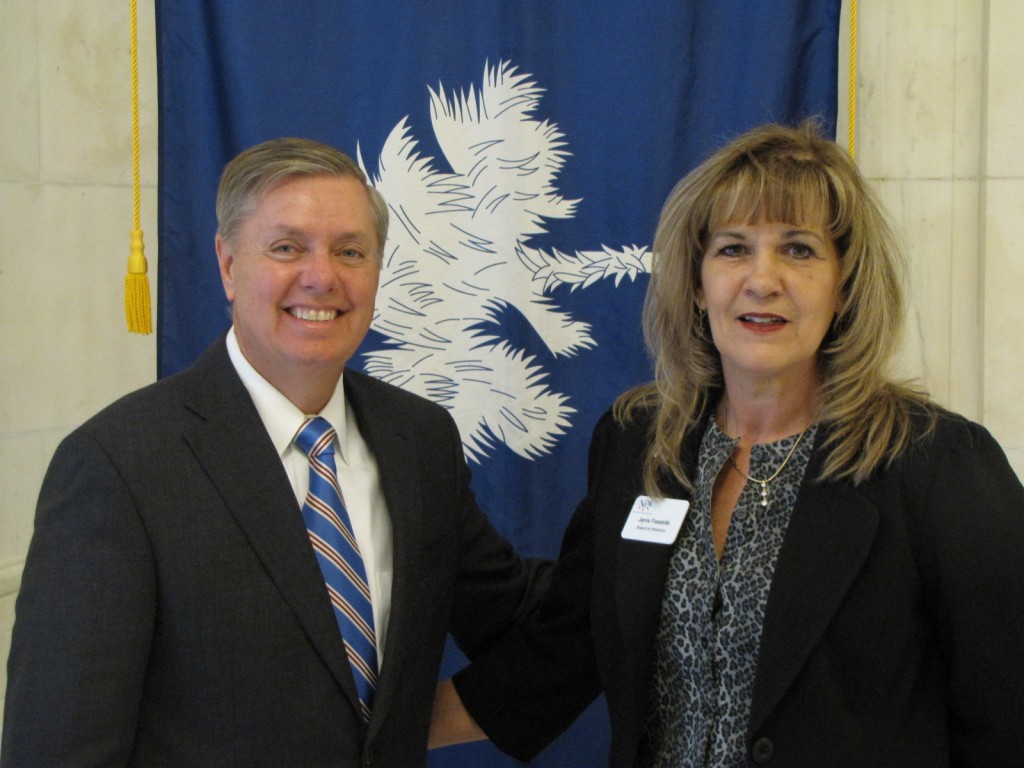
Janis Feazelle with Senator Lindsey Graham
January 15, 2015
A Personal Note from Taft Matney — Managing Principal; TMPR
The always ubiquitous “they” say, “You never forget your first.” That “first” can mean any number of things, but for us, that “first” is bittersweet today.
Anybody who knows me well knows how much I loved spending time with my grandfather when I was a kid. He was a lint head, a Textile League baseball player, a naval NCO, a veteran, a civil service supervisor, a homebuilder, a hack golfer, a Shriner, and a lover of Christ, family, and hard work.
He was a Yellow Dog Democrat who, even though he was one of the most conservative people I ever met (even to this day), wouldn’t have voted Republican if you held him at knifepoint.
He also bought and sold “stuff.” It could be anything. Gold, silver, diamonds, guns, Christmas trees, antique cash registers, clocks… You name it. If he thought he could “make a nickel” he’d buy it and sell it, and he ALWAYS made his nickel.
He spent a lot of time in pawn shops, too, so as a kid attached to his grandfather’s hip, that meant I spent a lot of time in pawn shops. My parents hated it. They saw it as a seedy environment their son didn’t need to be a part of. To my knowledge, they never crossed the threshold in to a pawn shop.
Their perception was vastly different from my reality.
When I’d go in to pawnshops, I met police officers who were sitting around shooting the breeze on a break. I met politicians from local officials to state legislators (In fact, the first time I met Senator Mike Fair a million years ago, it was in a pawn shop.). I met preachers from almost every faith. “Reverends to rabbis,” I used to joke.
I also met the pawnbrokers’ customers.
As I’d sit quietly watching my grandfather hold court and listening to him spin another tale or while I walked around looking at a shop’s inventory, I listened to the customers’ own stories.
They were there because they needed a quick loan for groceries until pay day. They were there because they needed to make payroll, and pawning items was easier than getting a bank loan for a few days. They were selling their engagement and wedding rings because a husband left with his secretary. They were there because the kids didn’t play with the Atari any more. They were selling old jewelry because they needed money to buy birthday or Christmas presents for the kids.
Customers don’t just come to pawn shops to sell, though. They come to buy.
They may be gun collectors looking for new firearms. They may want a Rolex but don’t want to pay retail. They may be searching for that perfect diamond for an engagement ring and don’t want to trudge through a mall to look because they want something with character and a story. They may be musicians looking for a vintage guitar or a craftsman hoping to find that rare tool he just can’t locate at a Big Box.
I saw pawn shops as pockets of market-driven commerce with buyers and sellers and supply and demand.
Fast forward to me as a grown-up.
After I launched TMPR in mid-2001, I began shopping around to jumpstart the governmental affairs side of our firm. One day in 2002, I got a call from a friend of mine who was serving in the House at the time.
“Hey, Taft,” he said. “I have a trade association who is looking for someone to monitor legislation for them. They got proposals from the Columbia firms, and it’s way out of their price range. Would you be interested in talking to them?”
Thinking it would be rude to simply reply, “Duh,” I changed it to something along the lines of, “Sure. I think I could do that.”
This House member had the person call me. I answered the phone to hear a kind of raspy Midlands Southern accent on the other end. “Mr. Matney?” I laughed in my own head because I was 29 years old and nobody had ever called me that before. “Please. I’m just Taft,” I responded and still do today.
“Taft. My name is Janis Feazelle. I’m the president of the South Carolina Pawnbrokers’ Association. We’ve been searching for a firm who can monitor legislation for us and let us know when we need to be active. We’re trying to find someone who is willing to learn about the pawn industry and who we can afford. It seems like the people down here think they’re working in Washington and charge those kinds of rates. Would you be interested in meeting me to talk about it?”
At the risk of being redundant, thinking it would be rude to simply reply, “Duh,” I changed it to something along the lines of, “Sure. I think I could do that.”
So, we met at for lunch at California Dreaming in Columbia.
We chatted about this and that before getting down to business. We talked about family. We talked politics. We talked about where we came from, and it turned out she knew one of my college fraternity brothers and his wife. The food came, and she blessed it as an almost unconscious reflex.
As we ate and talked, she started asking what I knew, if anything, about the pawn industry. I told her the same things I already wrote at the top of this piece, and she started grinning. Then she started smiling. Then she started laughing.
By the time lunch was finished, I signed the South Carolina Pawnbrokers’ Association as TMPR’s first governmental affairs client. More importantly, I made a new, real friend named Janis Feazelle.
The 2015 legislative session began this past Tuesday, but yesterday morning my phone rang at 7:18. Since we were trying to get the little man ready for school and me ready to head to Columbia for a day of meetings and inauguration, I let the phone go to voicemail.
After I dropped of my 11 year old clone at school and began making my way down I-385, I listened to the voicemail. It was one of the pawnbrokers I’ve known since I was a kid riding shotgun with my grandfather.
The message was quick but somber. “Taft, this is Jim. Please do me a favor and call me when you get this.” Something wasn’t good. You know that feeling.
I called him back immediately, and he proceeded to tell me that he didn’t have all of the details yet, but that my friend Janis had gone in to the hospital unexpectedly and had passed away shortly after midnight.
The rest of the day was a blur. There was so much to do to keep everything normal, but for me there was a cloud hanging overhead. In the midst of inauguration and talking about legislation we’re working on, there was the job of talking with specific legislators and state-level department officials to let them know that the Pawnbrokers’ Association’s president passed away only hours before.
Then there was the hour and a half drive home from Columbia. Usually that drive is reserved to clear my head, but yesterday, that drive was about reflection — reflection for another friend who passed, reflection on the difference she made in people’s lives every day she breathed, and reflection on the first person to say to TMPR, “We want you to handle our governmental affairs work.”
Since we started TMPR in 2001, our clients may start as clients, but more often than not, they develop in to partnerships and friendships. Janis Feazelle (whether she knew it or not) was instrumental in the way we established our client relationships from that point forward.
You never forget your first. Thank you, Janis.
