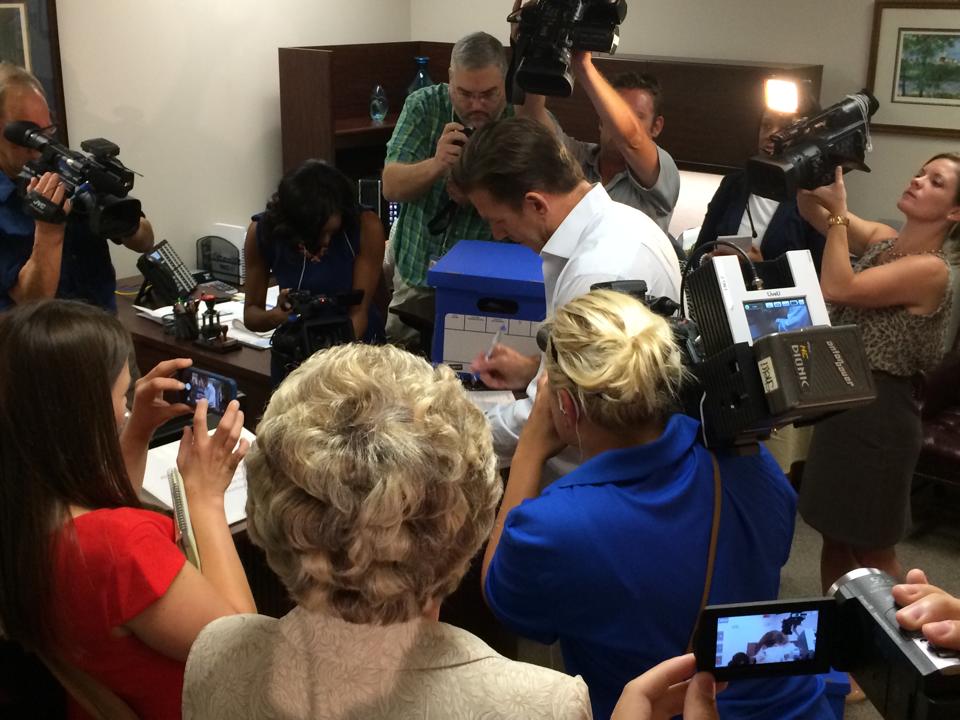
Thomas Ravenel Submitting Petitions in Columbia on July 14, 2014.
By: Taft Matney — July 15, 2014
FOREWORD: To be clear, with all of the questions surrounding Thomas Ravenel’s citizenship, this isn’t a will he win/won’t he win political piece. This is based only around the question of whether he could serve if elected.
After promising to do it, Thomas Ravenel presented officials in Columbia with petitions containing a reported 16,469 signatures. If at least 10,000 of them are valid, that’s enough to get South Carolina’s former state treasurer on the November 2014 general election ballot to challenge Senator Lindsey Graham along with state Senator Brad Hutto.
That’s his first hurdle.
While it’s HIGHLY unlikely that Ravenel would succeed in a bid to upend South Carolina’s senior senator, it’s not a legal impossibility even though a number of observers have suggested, and this is paraphrasing, “He renounced his citizenship. He can’t serve.”
Well…
OK, for fun let’s move forward under the belief that Ravenel’s citizenship renunciation held water (We’ll get to that in a minute.).
Article I, Section 3, Clause 3 of the Constitution simply states that:
“No Person shall be a Senator who shall not have attained to the Age of thirty Years, and been nine Years a Citizen of the United States, and who shall not, when elected, be an Inhabitant of that State for which he shall be chosen.”
Ravenel is 21 (closing in on 22) years north of 30, and he does inhabit the State of South Carolina, so he automatically has two out of three.
It’s the “nine Years a Citizen of the United States” part that potentially brings an interesting constitutional question.
Again, assuming that renouncing his citizenship was legitimate, he was a United States citizen for many more years than the required nine. The question of his eligibility could fall in to a court’s hands.
The Constitution doesn’t SPECIFICALLY say the person has to be a US citizen NOW (or with other qualifiers like “presently” or “currently” or “at the time of election”). It just says “nine Years a Citizen of the United States.” Could a court rule that even though Ravenel renounced his citizenship he satisfied the nine year clause prior to doing it and is therefore eligible to serve in the United States Senate? It’s doubtful such a ruling would be handed down, but COULD it? Talk amongst yourselves.
What about the renunciation itself?
As he posted on Facebook, the “star” of Bravo’s “reality” show “Southern Charm” wrote in October 2011:
“Even if I’m in a home where there’s a gun or even just a single bullet the govt. would construe that as constructive possession according to legal counsel which would guarantee me 15 years in federal prison without parole. After carefully weighing my options and not wanting to put my freedom in jeopardy every time I visit my family or friends I’ve decided to renounce my American citizenship and live where I can be free.”
The renunciation was short-lived because Ravenel later took to Facebook again to say that after more research, “renouncing my citizenship is not a viable option.”
Does that mean he’s an American citizen again? Just because nobody called “no takebacks” is it really that easy to reclaim citizenship?
We need to answer the latter first, and that answer is, “No.” It’s not that easy to reclaim citizenship.
In fact, Title 8, Chapter 12, Subchapter III, Part III of the US Code notes that a person over the age of 18 is committing an irrevocable act when he or she renounces American citizenship, and the action cannot be canceled or reversed without successfully appealing it through administrative or judicial channels. In other words, once it’s done, it’s pretty much done…forever.
Now we go back and look at the former question, and the answer is, “Yes.” Thomas Ravenel IS an American citizen. Why?
A person who is at least 18 (and we established that Ravenel hit that mark some time ago), can voluntarily renounce his or her US citizenship according to the US Code as long as certain actions are taken with the intent of renouncing citizenship. These actions may include appearing in person to an American diplomatic or consular officer in a foreign country and signing an oath of renunciation. There are a few other ways to do it, but the simple answer is that getting on Facebook and posting, “I’ve decided to renounce my American citizenship and live where I can be free,” doesn’t fit the bill as far as the US State Department is concerned.
In a nutshell, that’s it. Thomas Ravenel is an American citizen, he never legally renounced his citizenship, and he theoretically could be elected to the United States Senate. Of course, he has little to no chance of being elected, but that’s a political / campaign discussion for another day.
Here’s an extra question just to think about, though. Ravenel admitted that many of the signatures on his petition were paid for, but he didn’t say by whom. Do you think he used his personal finances to fund the paid petition drive OR do you think the Bravo television network picked up the tab to ensure a US Senate campaign in the storyline of “Southern Charm” season two (even though Ravenel tweeted on June 2 that he wouldn’t be a part of it)? Think that’s far fetched? Remember, we’re talking about South Carolina politics, and much stranger things have happened.
UPDATE (7/15/14 at 2:54 p.m.): That “extra question just to think about” may not be too far out of the realm of possibility. Greenville’s NBC affiliate WYFF is now reporting that despite his June 2 tweet stating that he would not, Ravenel “has decided to participate in the second season of Bravo’s ‘Southern Charm’ reality television show.” So, could Bravo — either directly or indirectly — be in some way responsible for Ravenel’s petition drive? While filming isn’t expected to begin until August, having a full-blown Senate campaign as a plot line can’t do anything but increase ratings. Since the show won’t air until after the November election, “equal time” provisions would not apply the way they did when Fred Thompson had to leave NBC’s “Law and Order” during his 2008 presidential bid. Like I said before, we’re talking about South Carolina politics. Much stranger things have happened.
Taft Matney is the managing principal with TM Public Relations & Governmental Affairs, a South Carolina-based strategic communications, planning, and advocacy firm.
Follow TMPR on Twitter and “like” TMPR on Facebook.
This op-ed may be reprinted/reposted in whole or in part upon written notification to and permission from taft@taftmatney.com.
Brand names, product names, services, companies, events, and publications are or may be trademarks or registered trademarks of, and are used to identify, products or services of their respective owners in the U.S. and/or other countries.
PHOTO CREDIT: Thomas Ravenel on Facebook
